


Invited Lecture
INVITATION
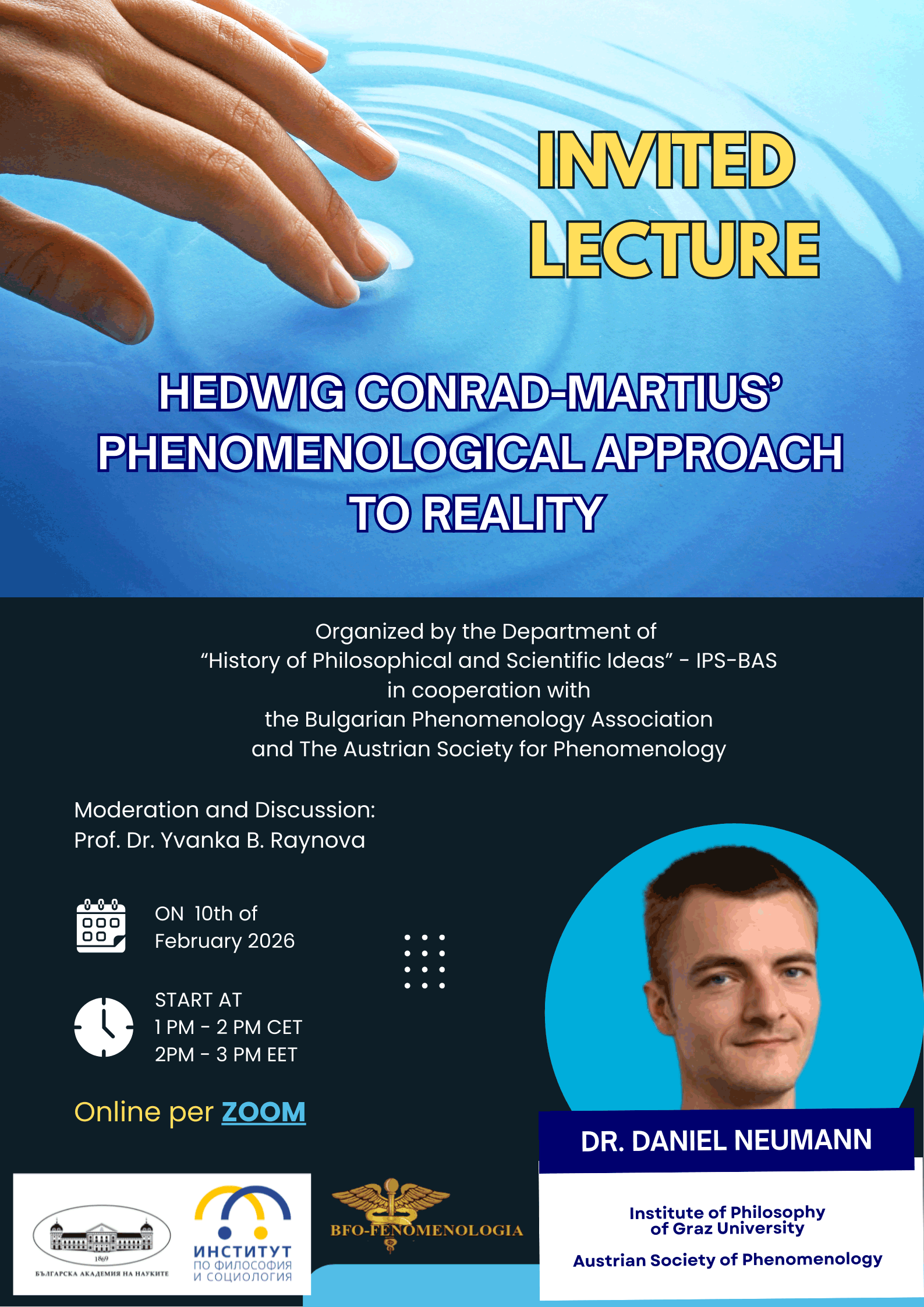
INVITED LECTURE
"Hedwig Conrad-Martius Phenomenological Approach to Reality"
Guest lecturer: Dr. Daniel Neumann,
Research Associate at the Institute of Philosophy of the University of Graz,
President of the Austrian Society for Phenomenology
Organizers:
Department of "History of Philosophical and Scientific Ideas"
of the Institute of Philosophy and Sociology of the Bulgarian Academy of Sciences
in cooperation with the Bulgarian Phenomenology Association and the Austrian Society for Phenomenology
The Invited Lecture is part of the department's series of seminars, lectures, and conferences
"Virtuality and Reality: Phenomenological and Post-Phenomenological Interpretations."
The Lecture will take place online on February 10, 2026, at 1 p.m. CET / 2 p.m. EET, on Zoom.
Join Zoom Meeting
https://us06web.zoom.us/j/86831093918?pwd=wqc05w3ayROepXNYDhfuOObbXOmsyX.1
Meeting ID: 868 3109 3918
Passcode: 988741
ABSTRACT
In her 1922 work of Realontologie, the early phenomenologist Hedwig Conrad-Martius seeks to establish an ontology based on phenomenological insights. The basic idea is that phenomenology makes available the mind-independent features of experienced objects, which can subsequently be used in order to systematically elaborate an ontology spanning the formal and material specifications of objects. Conrad-Martius therefore rejects the idea that experienced objects only provide us with a relative view of reality. Her aim is to show instead that we do not only directly encounter real objects as such, but that this encounter can be fruitfully and systematically exploited to establish an ontology. In this context, the modifier “real” in realontology refers to the contention that this ontology is informed by the impression of the existence of objects. One of the most controversial theses offered by Conrad-Martius is our having direct access to mind-independent features, essences, or intrinsic natures, of the things we encounter in experience. My proposal will therefore concentrate on expounding and discussing how Conrad-Martius aims to make this idea plausible. On a formal-ontological level, this is done via the introduction of “real-ontological” categories, i.e.., categories that pertain to things insofar as they exist. Thus, by contrast to familiar categories which formally or materially designate things in themselves, the categories in question here involve a relation to the observer for whom their existence makes a difference. They are relational categories. One of these is corporeality (Leibhaftigkeit). For a thing to exist is for it to exhibit corporeality. This category does not apply to all existing things in the same manner. Phenomenological investigation has to determine how the essence of the thing (formally containing, qua existing, corporeality) is embodied in the case of different kinds of existing objects. While the formal ontological notion of an object in Husserl refers to a subject of possible predication, the formal real-ontological notion of an object in Conrad-Martius refers, in terms of corporeality, to a bodily self-presence, realized differently by different kinds of beings (i.e., it is not a material-ontological notion). The aim of realontology here is to determine what a thing is in itself, such that it can affect us in the way it does. For this, we need a phenomenological account of the relation in which stand to the object, and an ontological account of what it is, in categorial terms, we thereby stand in relation to. I will proceed in three steps. Firstly, I will sketch the basic phenomenological presuppositions at play in Conrad-Martius’ philosophy, specifically her emphasis on a form of direct realism and on the reciprocal relationship expressed in the idea that we can cognize intrinsic features of existing objects based on our experience of them. Secondly, I present some central concepts of her ontology, including the distinction between substance and essence and her real-ontological category of corporeality which is subdivided further into touchability (Tangierbarkeit) and auto-position (Eigenposition) etc., in order to show how the experience of mind-independent features is addressed and captured using these categories. Thirdly, I will raise and some critical questions regarding her basic suppositions along the following lines: what exactly constitutes phenomenological evidence for the proposed kind of essence intuition, considering that the perception of external objects is principally fallible? More generally, in how far do epistemological and ontological concerns collapse in the phenomenology of Conrad-Martius? |